On this page
- What Makes Soomaa Different — Estonia’s “Fifth Season” Explained
- The Trails and Boardwalks — Walking Into the Bog
- Canoeing the Floodplains — the Park’s Signature Experience
- Wildlife — What You’ll See and When
- Tracking the Fifth Season — When Does the Flood Actually Come?
- Guided Tours and Local Operators in 2026
- Day Trips from Soomaa
- Where to Stay Near Soomaa
- Getting to Soomaa
- Best Time to Visit — Seasons at Soomaa
- Practical Tips for Bog and Wetland Travel
- Budget Breakdown — What a Soomaa Trip Costs in 2026
- Frequently Asked Questions
💰 Click here to see Estonia Budget Breakdown
💰 Prices updated: August, 2026. Budget figures are estimates — always verify before travel.
Exchange Rate: $1 USD = €0.86
Daily Budget (per person)
Shoestring: €45.00 – €70.00 ($52.33 – $81.40)
Mid-range: €120.00 – €170.00 ($139.53 – $197.67)
Comfortable: €250.00 – €420.00 ($290.70 – $488.37)
Accommodation (per night)
Hostel/guesthouse: €10.00 – €40.00 ($11.63 – $46.51)
Mid-range hotel: €50.00 – €140.00 ($58.14 – $162.79)
Food (per meal)
Budget meal: €10.00 ($11.63)
Mid-range meal: €25.00 ($29.07)
Upscale meal: €80.00 ($93.02)
Transport
Single metro/bus trip: €1.50 ($1.74)
Monthly transport pass: €30.00 ($34.88)
Soomaa National Park doesn’t appear on many international radar screens yet, and in 2026 that’s still largely true — which is exactly why it rewards the travelers who do show up. The park sits in southwestern Estonia, covering about 390 square kilometres of raised bogs, floodplain forests, and slow rivers, and it operates on its own schedule. If you’re planning a visit based on what you saw on Instagram six months ago, the landscape you find might look completely different. That unpredictability is the whole point.
What Makes Soomaa Different — Estonia’s “Fifth Season” Explained
Estonians count four seasons like everyone else, and then they add a fifth: üleujutus, the spring flood. Every year, usually between late March and early May, snowmelt from the surrounding uplands pours into the Halliste, Raudna, Lemmjõgi, and Navesti rivers simultaneously. The rivers can’t drain fast enough. Water backs up across the floodplain forests and into the lower bog margins, sometimes raising water levels by five metres above summer low.
The result is a temporary inland sea. Forests stand knee-deep in black water. Meadows that were frozen solid two weeks earlier become navigable by canoe. Roads flood. Some farmsteads become islands. Local families have kept dugout canoes — haabjas — for generations specifically for this period, and the tradition is still alive in the villages bordering the park.
What makes Soomaa genuinely unusual, even compared to other wetland parks in northern Europe, is how abruptly the flood arrives and recedes. You can drive to the park on a Friday and find dry forest trails. Return the following Tuesday and those same trails are under half a metre of cold, amber-coloured water. The park’s character shifts more dramatically between visits than almost any other protected landscape in Estonia.
The Trails and Boardwalks — Walking Into the Bog
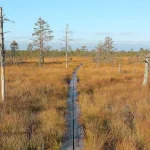
Outside flood season, Soomaa has five marked trails and a network of boardwalks that cross terrain you genuinely cannot walk without them. The raised bogs — rabad — sit above the surrounding landscape, built from thousands of years of compressed sphagnum moss. The surface is alive and unstable. A boardwalk here isn’t a luxury; it’s what keeps you from sinking to your thigh in cold, acidic peat water.
Riisa Bog Trail
This is the park’s most accessible introduction to raised bog walking. The boardwalk loop runs about 1.6 kilometres and crosses the open laukad — the shallow, tea-dark bog pools — that define central Estonian mire landscapes. On a clear morning, the surface steams lightly. The sphagnum moss under your feet compresses and springs back with each step, and the silence here is complete except for wind and occasional sandpiper calls. The trail starts at the Riisa parking area off Road 92 and takes roughly 40 minutes at a relaxed pace.
Ingatsi Bog Trail
Longer at 3.5 kilometres, this trail takes you deeper into the bog’s interior and passes through the transition zone between wet forest and open mire. In late summer, the bog rosemary and cloudberry plants are visible along the boardwalk edges. It’s easy to underestimate the exposure here — the open bog has no shelter from sun or wind, and the distances feel deceptive when every direction looks the same.
Kuresoo Big Bog Trail
Kuresoo is Soomaa’s largest and most remote bog section. The trail system here covers up to 11 kilometres if you combine all branches, and it includes an observation tower with views across an unbroken peat landscape that stretches to the horizon. This is where you understand the scale of what you’re standing on. The walk to the tower takes about 90 minutes one way from the trailhead near Tõramaa.
Beaver Trail and Ilvese Trail
These two shorter loops, each under 3 kilometres, run through the riparian forest zones along the river corridors. They’re the best options during or just after flood season when the bog surface is too saturated for safe walking. The Beaver Trail in particular shows clear signs of beaver activity — gnawed stumps, dammed side channels, and the occasional fresh mud slide on riverbanks. Walk quietly and slowly and you have a real chance of seeing them at dawn or dusk.
Canoeing the Floodplains — the Park’s Signature Experience
If there’s one thing Soomaa is built around, it’s paddling. The park’s slow, clear rivers are beautiful in normal conditions. During the fifth season they spread across the forest floor and the rivers effectively disappear into an enormous shallow lake threaded with submerged trees.
Paddling through flooded forest is a surreal experience. You navigate between oak and alder trunks, dipping your paddle between root systems that would normally be a metre above your head. The water is cold — typically 5–10°C in April — and very clear. You can see the leaf litter of the forest floor below you. Sounds carry differently over open water, and the birdsong in flooded forest during spring migration is extraordinary.
Outside flood season, the rivers are still excellent for multi-day canoe trips. The Halliste to Pärnu route via the Navesti is a classic 3–4 day paddle with camping options along the way. Current is gentle, portages are minimal, and the riparian scenery changes constantly between open meadow, dense alder carr, and sections of mature floodplain oak forest.
Self-guided canoe rental is available from several local operators near the park (see the Guided Tours section). A single canoe or Canadian canoe for two people runs €25–€40 per day in 2026 depending on the vessel and operator. Kayaks are also available. Operators will drop boats at your chosen put-in and collect them from your take-out point for an additional transport fee of around €15–€25.
Wildlife — What You’ll See and When
Soomaa supports a full range of Estonian woodland and wetland species, and because visitor numbers remain low compared to Lahemaa or the islands, encounters feel genuinely wild rather than managed.
Beavers are everywhere. Estonia has one of Europe’s densest beaver populations and the rivers here show it — you’ll see active dams, bank lodges, and gnawed timber on almost every paddle. Seeing an actual beaver requires patience and early starts, but it happens regularly for people who try.
White storks return to the meadows around the park from late April. The sight of storks picking through a flooded meadow while you drift past in a canoe is one of those images that stays with you. Black storks, shyer and rarer, nest in the old-growth sections and are occasionally seen in riparian forest.
Brown bears, wolves, and lynx all have established territories in and around Soomaa. You won’t see them on a casual visit — but tracks in soft mud along the riverbanks are common, especially in spring. In 2026, the park’s camera trap network has documented all three species regularly in the Kuresoo zone.
Elk (moose) are the large mammal you’re most likely to actually see. They browse in forest clearings and along river edges at dawn and dusk. Driving the park roads slowly in early morning in May or September gives you a reasonable chance of an encounter.
For birds, spring migration through the flooded forests in April is arguably the best single reason to time a visit around the fifth season. Waders, ducks, and woodland birds all concentrate in the floodplain during this period.
Tracking the Fifth Season — When Does the Flood Actually Come?
This is the question every visitor asks, and the honest answer is that nobody knows exactly. The flood depends on accumulated snowpack, the timing of the spring thaw, and rainfall in late winter. In a warm year like 2024 was, significant flooding arrived in early March. In a cold year, it might not peak until late April or even early May.
What you can do is track it. The Estonian Environment Agency (Keskkonnaamet) publishes real-time river gauge data online, and the Soomaa visitor centre specifically monitors the Halliste river level at Kärevere. When that gauge passes roughly 2.5 metres, the forest roads inside the park start flooding. At 3.5 metres, canoe access into the forest becomes possible. At 4.5 metres or above, you’re in a genuine fifth season event.
The safest approach for international travelers is to plan a trip in the second half of March through mid-April, book accommodation with free cancellation, and watch the gauges for 10 days before you travel. If levels are rising fast, come immediately. If it’s been a warm dry winter, you might arrive to find normal forest conditions — which are still beautiful, just different.
Guided Tours and Local Operators in 2026
Guided experiences in Soomaa are run by a small group of local operators, most of whom have been working in the park for 10–20 years. This is not a slick commercial tourism sector — these are knowledgeable individuals and small family businesses who know the park intimately.
Soomaa.com (operated by Aivar Ruukel, who is closely associated with the fifth season concept internationally) offers canoe trips, guided bog walks, and traditional haabjas dugout canoe experiences. A half-day guided canoe trip runs approximately €45–€65 per person in 2026. Full-day flood season paddles cost around €75–€95 per person including equipment.
MTÜ Soomaa Turism and several guesthouses around Tõramaa and Kõrtsi offer self-guided canoe packages with route maps and shuttle logistics. These work well for experienced paddlers who want flexibility.
Haabjas dugout canoe experiences — where you carve a short section of a log boat and then test it on the river — run about €35–€50 per person and need to be booked at least a week in advance. They’re more popular than ever in 2026 with visitors interested in hands-on heritage experiences.
Day Trips from Soomaa
Viljandi — 45 km northeast
The nearest town of real character, Viljandi sits above a glacial lake and contains a ruined Livonian Order castle, a lively café culture, and one of Estonia’s best traditional music festivals (late July). It’s a 45-minute drive from the park centre. Spend half a day here on any visit — the old town is walkable and the views from the castle hill are worth the short climb.
Pärnu — 65 km west
Estonia’s summer capital sits on the coast and offers a complete change of atmosphere from the bog. The beach promenade, outdoor restaurants, and the Rannahotell spa make it an easy afternoon excursion from Soomaa. In 2026, the Pärnu-Tallinn Rail Baltica station is under active construction and the town centre has some new pedestrian infrastructure, so traffic patterns near the harbour have changed.
Kurgja Farm Museum — 30 km southwest
This open-air museum preserves a 19th-century Estonian farmstead associated with Carl Robert Jakobson, a key figure in the Estonian national awakening. The site is genuinely evocative — old thatched buildings, a working smoke sauna, and peaceful grounds. It receives very few foreign visitors and is all the better for it. Entry costs around €5 in 2026.
Where to Stay Near Soomaa
There are no hotels inside the national park. Accommodation clusters in the surrounding villages, particularly around Tõramaa, Kõrtsi-Tõramaa, Riisa, and along Road 92 between Viljandi and Pärnu.
Budget (€30–€55/night): Basic guesthouses and farm stays are available around Tõramaa. Facilities are simple — shared bathrooms are common at the lower end — but hosts are typically knowledgeable about the park and genuinely helpful with logistics.
Mid-range (€60–€110/night): Several well-established guesthouses offer private rooms with bathrooms, sauna access, and canoe rental on-site. Soomaa Guesthouse at Tõramaa and Metsakodu are frequently recommended by return visitors. Booking 4–6 weeks ahead is essential during the spring flood season.
Comfortable (€120–€200/night): A handful of private holiday cottages near the park boundary rent by the night or week. These suit families or small groups and usually include a private sauna, a small dock or river access, and full kitchen facilities. Availability at this tier is limited — book 2–3 months ahead for April.
Wild camping is permitted in designated areas within the park. There are several marked camping spots along the river corridors with basic facilities (fire pit, composting toilet). These cost nothing but require a camping permit, available from the visitor centre.
Getting to Soomaa
Soomaa sits roughly 150 km south of Tallinn and 130 km southeast of Pärnu. There is no direct public transport into the park — this is one of those destinations where a car is not a convenience but a genuine necessity for most visitors.
From Tallinn, drive south on the E67/Route 4 toward Pärnu, then cut east toward Viljandi via Märjamaa and Pärnu-Jaagupi. The park’s Tõramaa visitor centre is well-signed from Road 92. Total drive time is about 2 hours.
From Tartu, the drive runs about 1.5 hours via Viljandi. From Pärnu, it’s under an hour.
If you’re arriving without a car, take a bus to Viljandi (frequent connections from Tallinn and Tartu) and arrange a taxi or pre-booked transfer to the park from there. Several tour operators will collect guests from Viljandi bus station as part of a guided package. In 2026, the Bolt app covers taxi bookings in Viljandi with reasonable reliability, though pre-booking for early morning pickups is strongly advised.
The park’s internal roads are mostly gravel. After heavy spring flooding, some sections are impassable or have soft shoulders. A standard passenger car is fine in summer and autumn. In spring, check road conditions with the visitor centre before driving the forest tracks toward the bog trailheads.
Best Time to Visit — Seasons at Soomaa
Spring (March–May): The fifth season window and the most dramatic time to visit. April is peak flood potential. Temperatures range from 0–14°C. Insects are minimal. Birdlife is exceptional. The park is at its most unique and most unpredictable. This is when to come if you want the experience that defines Soomaa.
Summer (June–August): The park dries out, trails become fully accessible, and the forest is dense and green. Water levels are low, making the river paddle a slower, quieter experience. Mosquitoes and horseflies are a real factor in June and July — take repellent seriously. Temperatures reach 20–25°C on good days. The park is genuinely beautiful but less extraordinary than in spring.
Autumn (September–October): Excellent for bog walking. The sphagnum takes on deep red and orange hues, cloudberries ripen in September, and the insect pressure disappears after the first cold nights. Light is beautiful in October. Occasional autumn floods happen when heavy rain combines with early snowfall, offering a minor fifth season preview.
Winter (November–March): The bog freezes solid in deep winter, allowing bog walking without boardwalks and revealing the landscape’s structure in a way that’s impossible in warmer months. Snowshoeing is possible from December through February. The visitor centre has reduced hours but remains open. This is a genuinely rewarding season for visitors who embrace cold-weather travel.
Practical Tips for Bog and Wetland Travel
Footwear: Rubber boots (wellies) are essential for any bog walking beyond the main boardwalk systems. Waterproof hiking boots work on the main trails but will get wet if you step off boardwalk. Bring both if you plan to do a guided bog walk.
Insects: June and July mosquito pressure in the forest and floodplain is severe by any standard. Long sleeves, long trousers, and a DEET-based repellent are not optional. Head nets are worth carrying in June. After mid-August, insect pressure drops significantly.
Ticks: The park sits in one of Estonia’s higher-risk tick zones. Check yourself thoroughly every evening from April through September. TBE (tick-borne encephalitis) vaccination is recommended for visitors spending multiple days in forested areas — this is a standard recommendation across all of northern Estonia’s forests in 2026.
Water temperature during floods: The floodwater in spring is cold — typically 5–10°C in April. Canoe trips require appropriate layering. A capsize in flood conditions is serious. Wear a buoyancy aid. Operators provide them; never paddle without one during the fifth season.
Navigation: The open bog looks identical in every direction. The boardwalks are clearly marked but leave the boardwalk without a compass or GPS and you will get disoriented quickly. Even in summer, a GPS track and offline maps (Maps.me or OsmAnd cover the park well) are worth having.
Mobile coverage: Telia and Elisa have coverage at the visitor centre and along Road 92. Inside the forest and on the open bog, signal is unreliable. Download offline maps before you enter.
Budget Breakdown — What a Soomaa Trip Costs in 2026
Budget traveler (€60–€85/day): Staying in a basic guesthouse (€35–€50/night), self-catering or eating simple meals in Viljandi, renting a canoe independently (€25–€30), and sticking to free trail access. Transport costs are the wild card — car hire from Tallinn adds roughly €40–€55/day for a basic vehicle.
Mid-range traveler (€110–€160/day): Mid-range guesthouse with sauna (€70–€90/night), one full-day guided canoe or bog walk tour (€65–€80/person), meals at local guesthouses or Viljandi restaurants (€15–€25 per meal). Car hire included in the daily estimate.
Comfortable traveler (€180–€260/day): Private cottage rental (€130–€180/night split between two people), daily guided experiences, meals at better restaurants in Viljandi or Pärnu, and a haabjas experience. This tier offers the most flexibility and the most access to expert local knowledge.
Entry to the national park itself is free. The visitor centre is free. Marked trails are free. The main costs are accommodation, guided tours, and getting there — car hire being the most significant variable for international visitors.
Frequently Asked Questions
When exactly does the fifth season flood happen in Soomaa?
There’s no fixed date — it depends on winter snowpack and spring temperatures. In most years, the main flood window falls between late March and late April. Some years it peaks in early March; in cold years, it can extend into May. Track the Halliste river gauge via the Estonian Environment Agency website and check with the Soomaa visitor centre for real-time updates before your trip.
Do I need to book a guided tour, or can I explore Soomaa independently?
Independent visits are completely possible and free on all marked trails. Canoe rental is available without a guide. However, for flood-season paddling through submerged forest, a local guide significantly improves safety and helps you find the best access points, which change as water levels shift. First-time visitors usually find a half-day guided session worth the cost.
How do I get to Soomaa National Park without a car?
Take a bus to Viljandi — there are regular services from Tallinn and Tartu. From Viljandi, book a taxi via Bolt or arrange a transfer with your accommodation or tour operator in advance. Public transport does not reach the park directly, so plan the last leg carefully.
Is Soomaa suitable for children?
Yes, with age-appropriate activities. The Riisa Bog boardwalk trail is easy enough for children aged 5 and up. Canoe trips are popular with families — children from around age 7 can participate comfortably in calm conditions. Avoid taking young children on flood-season paddles through dense flooded forest, where conditions require more experience and cold-water safety awareness.
What should I pack for a Soomaa bog walk?
Rubber boots or waterproof hiking boots, long trousers and long sleeves (insect protection from May through August), a windproof jacket, DEET insect repellent, and a tick-check routine for the evening. Bring offline maps downloaded before you arrive. A small daypack with water and snacks is sufficient for the boardwalk trails — the longest loop is under 12 kilometres total.
Explore more
Estonia by Bus: Exploring Beyond Tallinn on a Budget
Things to Do in Telliskivi: Tallinn’s Creative Hub Uncovered
📷 Featured image by Margo Evardson on Unsplash.