On this page
💰 Click here to see Estonia Budget Breakdown
💰 Prices updated: August, 2026. Budget figures are estimates — always verify before travel.
Exchange Rate: $1 USD = €0.86
Daily Budget (per person)
Shoestring: €45.00 – €70.00 ($52.33 – $81.40)
Mid-range: €120.00 – €170.00 ($139.53 – $197.67)
Comfortable: €250.00 – €420.00 ($290.70 – $488.37)
Accommodation (per night)
Hostel/guesthouse: €10.00 – €40.00 ($11.63 – $46.51)
Mid-range hotel: €50.00 – €140.00 ($58.14 – $162.79)
Food (per meal)
Budget meal: €10.00 ($11.63)
Mid-range meal: €25.00 ($29.07)
Upscale meal: €80.00 ($93.02)
Transport
Single metro/bus trip: €1.50 ($1.74)
Monthly transport pass: €30.00 ($34.88)
Most visitors to Estonia tick off Toompea Castle in Tallinn and call it a day. That’s understandable — Tallinn is spectacular. But the castle ruins at Viljandi offer something Tallinn’s preserved old town simply cannot: the raw, unfiltered feeling of medieval collapse. In 2026, with Estonian cultural tourism pushing harder into the countryside, Viljandi is getting more attention than ever — and the site genuinely earns it.
What the Ruins Actually Are
The castle at Viljandi was built by the Livonian Order, a branch of the Teutonic Knights who controlled much of what is now Estonia and Latvia from the 13th century onward. Construction began around 1224, shortly after the Order’s conquest of the region during the Northern Crusades. At its peak, Viljandi Castle was one of the largest and most strategically important fortifications in the entire Baltic region — not a minor outpost, but a full-scale convent castle with multiple courtyards and towers.
The complex went through centuries of use, expansion, and damage. Russian forces destroyed much of it during the Livonian War in the 1560s, and what remained was gradually stripped for building material by local residents over the following two centuries. By the 19th century, when Romantic-era intellectuals began documenting Baltic heritage, what stood was largely what you see today: fragments of thick limestone walls, a dramatic suspension footbridge added in the 20th century, and a layout that rewards careful attention.
Architecturally, Viljandi represents the convent castle type — a rectangular residential block arranged around a central courtyard, with defensive wings extending outward. Even in ruin, you can read that plan on the ground. This is not a reconstructed heritage attraction. Nobody has added a gift shop inside a recreated gatehouse. The site is honest about what it is.
Walking the Site: What You’ll See Layer by Layer
The ruins sit on a ridge above Lake Viljandi, and the approach from the park below already sets the atmosphere. The surviving wall sections rise to around 10 metres in places, their surfaces rough with centuries of weathering. Stand close and you can see different phases of construction — earlier, cruder stonework at the base giving way to more refined masonry higher up, where expansion happened in the 14th and 15th centuries.
The most dramatic single element is the suspension bridge that crosses the old moat area and leads directly into the inner courtyard zone. The bridge itself dates from 1931 and was renovated in the early 2000s — it sways slightly as you walk, and below you can see the depth of the original defensive ditch, now softened by grass and small trees. The earthy smell of old stone and damp moss hits you the moment you step off the bridge onto the courtyard ground.

Inside the courtyard perimeter, interpretive panels installed during a 2022 restoration project explain the original building functions: the chapter house, the dormitory wing, the chapel position. The panels are in Estonian, English, and German — a nod to the site’s German-speaking heritage tourism audience. Ground-level outlines of former interior walls have been marked in stone, helping you mentally reconstruct the scale of what stood here.
The viewing platform on the northern wall gives the best perspective over Lake Viljandi below. On a clear day in early autumn, when the surrounding trees are turning, the combination of grey stone ruins, yellow foliage, and the flat blue-grey lake is striking in a way that photographs only partially capture.
The Castle Hill Park Setting
The ruins don’t exist in isolation. They sit within Viljandi Castle Hill Park, a landscaped green space that wraps around the ridge and descends toward the lake. The park is genuinely pleasant — old linden trees line the main paths, there are benches positioned to face the water, and a small outdoor stage near the lower park hosts performances during summer.
The park was formally established in the 19th century by local Baltic German landowners who had a taste for Romantic ruin aesthetics, which meant the ruins were actually preserved partly because they looked picturesque. That’s a strange historical irony: the same cultural movement that romanticised medieval ruins helped prevent further demolition. The linden allées they planted are now mature and enormous, providing deep shade in summer.
A short walking trail loops from the castle area down to the lakeside promenade and back up through a residential neighbourhood. The full loop takes about 45 minutes at a relaxed pace. This lower trail passes a small beach area where locals swim in summer — a reminder that Viljandi functions as a lived-in town, not a heritage museum.
Viljandi Festival Season and the Ruins as Cultural Backdrop
Every July, Viljandi hosts the Viljandi Folk Music Festival, one of the most respected folk music events in Northern Europe. In 2026, the festival runs from 24 to 27 July. While the main stages are scattered across the town, the castle ruins and Castle Hill Park become an integral part of the event’s atmosphere — smaller acoustic performances happen on and around the site, and the ruins are illuminated at night.

The festival draws around 25,000 visitors over four days to a town of roughly 17,000 residents. Accommodation books out months in advance during festival week. If your visit coincides with the festival, book accommodation in February or earlier. If it doesn’t coincide, July and early August are still the busiest periods simply because the weather is warmest.
Outside festival season, the ruins are significantly quieter. Spring (May to early June) is an excellent time: the lindens are coming into leaf, the lake reflects early light in the mornings, and you can have the courtyard almost entirely to yourself on a weekday. Winter visits are possible and have their own character — frost on the stone, fewer crowds, the ruins standing starkly against a pale sky.
Day Trip or Overnight?
Viljandi sits roughly 160 kilometres southeast of Tallinn and about 90 kilometres northwest of Tartu. Both distances make a day trip workable, but only just comfortable. From Tallinn, a return day trip means roughly five to six hours of travel time total, leaving you perhaps four hours in town — enough to see the ruins thoroughly and have a proper lunch, but not enough to explore the lake trail, the town centre, and the local museum.
From Tartu, the math works better. The journey is shorter, and you can be at the ruins by mid-morning with genuine time to spare. A day trip from Tartu is a reasonable choice, especially if you’re already spending several days in that city.
Overnight in Viljandi gives you the evening atmosphere (the old town is genuinely pleasant after dark, with a handful of good bars and restaurants), and it lets you catch the ruins at different light conditions — early morning light on the stone is notably different from afternoon sun. One night is sufficient for most visitors. Two nights only makes sense if you’re visiting during the folk festival or if you want to combine the ruins with a longer countryside walk or lake swim.
Getting to Viljandi in 2026
The most practical option remains the bus from Tallinn. Lux Express and several regional operators run multiple daily connections, with journey times around two hours and prices typically between 8 and 14 EUR depending on booking time. Buses arrive at Viljandi bus station, which is a 15-minute walk from the castle ruins.

By train from Tallinn, the journey currently requires a change, adding time. Elron operates services, but the routing is less direct than the bus. From Tartu, there is a direct regional train to Viljandi run by Elron — journey time roughly 1 hour 40 minutes, prices around 6 to 9 EUR. This is the most pleasant way to arrive if you’re coming from Tartu.
Rail Baltica, the major new rail corridor under construction through the Baltic states, does not serve Viljandi directly. The main Rail Baltica line runs through Pärnu. That said, improved connections from Tallinn’s upgraded Ülemiste transport hub, which opened expanded facilities in late 2025, make bus connections to regional destinations including Viljandi slightly more organised than before.
Driving remains the most flexible option if you’re planning to combine Viljandi with other countryside destinations — Soomaa National Park is only 40 kilometres west, making a logical two-site itinerary for anyone with a car.
2026 Budget Reality
Entry to the castle ruins themselves is free. The site is open and unfenced, accessible year-round at any hour. There is no ticket booth, no mandatory guided tour, no timed entry system. This may change if visitor numbers continue growing, but as of 2026 it remains completely open access.
The Viljandi Museum, which covers the castle’s history in depth with a permanent archaeology collection including finds from the site, charges a small entry fee. Adult tickets in 2026 are 5 EUR, with concession rates for students and seniors. The museum is housed in a handsome building in the town centre and is well worth an hour of your time before or after visiting the ruins — the physical artefacts, including weapons, decorative stonework, and domestic items, fill in what the site itself leaves abstract.
- Budget tier: Day trip on the bus from Tartu, ruins visit (free), packed lunch eaten in the park, museum entry — total spend under 25 EUR including transport.
- Mid-range: Bus from Tallinn, one overnight in a guesthouse (50–75 EUR per night), lunch at a local café (12–18 EUR), dinner in town (20–30 EUR), museum entry — roughly 110–140 EUR for two days.
- Comfortable: Private transfer or car hire, stay at one of the better-appointed apartments near the town centre (90–130 EUR per night), full restaurant meals, guided tour of the ruins available via the museum (approximately 35 EUR for a group) — total 200–270 EUR for two days.

Food near the castle is limited to a small café kiosk in the park during summer months (open May through August, selling coffee, pastries, and cold drinks). For a proper meal, walk 10 minutes into the town centre. Ugala Restoran near the theatre serves reliable Estonian and Central European cooking. Hans ja Grete is a more casual option popular with locals, with good open-faced sandwiches and daily soup specials.
Practical Tips Before You Go
The ruins are accessible in all weather, but the paths within the site can be slippery after rain, particularly on the stone surfaces near the suspension bridge. Wear shoes with grip. In winter, the bridge can ice over — step carefully and test before crossing at full weight.
Accessibility is limited. The suspension bridge and much of the inner courtyard terrain is uneven. Wheelchair users and visitors with limited mobility will find the park paths below the ruins enjoyable, but the castle interior itself is not wheelchair accessible. The town of Viljandi is actively working on improved accessibility infrastructure, but no upgrade to the ruins site is confirmed as of early 2026.
Guided tours in English can be arranged through the Viljandi Museum with advance notice — email them at least a week ahead during peak season. Spontaneous English-language tours are not guaranteed.
Dogs are permitted in the park and at the ruins on a lead. The site is popular with local dog walkers, particularly on weekend mornings — another reason to arrive early if you want quiet.
Photography is unrestricted. The ruins photograph best in morning light from the east-facing courtyard side, and in late afternoon from the lakeside viewpoint below, when the walls catch direct sun and cast long shadows downhill.
Frequently Asked Questions
How long does it take to visit the ruins?
Most visitors spend between 45 minutes and 90 minutes at the ruins themselves. Add another 30 to 45 minutes if you walk the lower lake trail through Castle Hill Park. Combining the ruins with the Viljandi Museum adds roughly one more hour. A half-day is comfortable for the full experience.
When is the best time of year to visit Viljandi Castle?
Late May and early June offer a good balance of mild weather, green surroundings, and smaller crowds. July brings the folk festival and warm temperatures but much busier conditions. Autumn colour in late September is genuinely beautiful against the grey stone. Winter visits are quiet and atmospheric but require warm layers and careful footing.
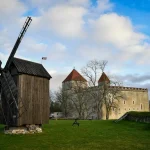
📷 Featured image by Mari Potter on Unsplash.