On this page
- A City with Two Souls: Understanding Narva’s Cultural DNA
- Hermann Castle and the Ivangorod Fortress: The View That Stops You Cold
- The Rebuilt City Center: Town Hall Square and Alexander Church
- Where to Eat and Drink in Narva
- Getting to Narva and Moving Around the City
- Day Trips from Narva: The Northeast Corner of Estonia
- After Dark: Narva’s Nightlife and Cultural Calendar
- Shopping in Narva: What to Look For
- Where to Stay in Narva
- When to Visit Narva
- Practical Information for Visiting Narva in 2026
- Narva Budget Breakdown: Daily Costs in 2026
- Frequently Asked Questions
💰 Click here to see Estonia Budget Breakdown
💰 Prices updated: October, 2026. Budget figures are estimates — always verify before travel.
Exchange Rate: $1 USD = €0.88
Daily Budget (per person)
Shoestring: €40.00 – €70.00 ($45.45 – $79.55)
Mid-range: €120.00 – €250.00 ($136.36 – $284.09)
Comfortable: €300.00 – €900.00 ($340.91 – $1,022.73)
Accommodation (per night)
Hostel/guesthouse: €15.00 – €40.00 ($17.05 – $45.45)
Mid-range hotel: €60.00 – €150.00 ($68.18 – $170.45)
Food (per meal)
Budget meal: €15.00 ($17.05)
Mid-range meal: €35.00 ($39.77)
Upscale meal: €100.00 ($113.64)
Transport
Single metro/bus trip: €2.00 ($2.27)
Monthly transport pass: €30.00 ($34.09)
In 2026, Narva sits at a crossroads that few European cities can claim. It borders Russia — literally separated by a river and a checkpoint — while being a full EU and Schengen member city. That combination creates a travel experience unlike anything else in the Baltics. Post-2022 tensions have reshaped how the border works, who crosses it, and what that means for visitors. If you’re planning a trip expecting a gloomy post-Soviet shell, you’re in for a surprise. Narva has quietly built a confident, complicated identity that rewards curious travelers.
A City with Two Souls: Understanding Narva’s Cultural DNA
Narva is Estonia’s third-largest city, and roughly 90% of its population is Russian-speaking. That figure has defined how outsiders perceive the city — often poorly, often inaccurately. What actually exists here is a place where Soviet-era apartment blocks sit alongside a restored baroque town hall, where Orthodox church bells compete with Lutheran silence, and where you’ll hear Russian in every café but pay in euros and live under Estonian law.
The tension between Estonian national identity and Russian cultural heritage isn’t hostile here — it’s layered. Since 2022, Estonian integration policies have accelerated. Language courses are widely available, Estonian-language schooling is now mandatory for new students, and many younger Narva residents move fluidly between both languages. You’ll see Estonian and Russian signage side by side. The old Soviet factory buildings — Narva was a major textile hub — now house creative studios and community spaces. The city isn’t trying to be Tallinn. It’s doing something more interesting: figuring out what it actually is.
That process of self-definition is exactly what makes Narva worth visiting. You’re not coming for polished tourist infrastructure. You’re coming to stand at the edge of the EU and look across a river at a country that has closed itself off from the world, and to understand — viscerally — what that border means.
Hermann Castle and the Ivangorod Fortress: The View That Stops You Cold
The Narva River is only about 200 metres wide at the crossing point. On the Estonian side: Hermann Castle, a 14th-century fortification with a tall tower and a distinctive silhouette. On the Russian side: the Ivangorod Fortress, larger, more brooding, built by Ivan III in 1492. The two castles face each other across the water — still, after all these centuries, eyeing one another.
Climbing Hermann Castle’s tower costs around €6 in 2026 and takes about 15 minutes. The view from the top is the defining image of Narva: the dark Narva River below, the Russian fortress filling your entire field of vision, and the silence of a border where passenger crossings have remained severely restricted since 2022. There are no tourist day trips to Ivangorod anymore — that era is paused. But that makes the view more affecting, not less. You’re looking at something unreachable from where you’re standing.
The castle grounds host the Narva Museum, which covers the city’s history from the medieval period through the Soviet years. The permanent exhibition is genuinely good — well-designed, bilingual in Estonian and English, honest about the complicated chapters. Budget about 90 minutes inside.
The Rebuilt City Center: Town Hall Square and Alexander Church
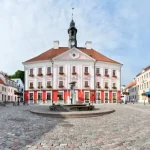
Narva was almost completely destroyed in World War II — around 98% of the historic Old Town was leveled. What you walk through today is partly reconstruction, partly Soviet-era infill, and partly new development. Town Hall Square (Raekoja plats) is the reconstructed baroque centerpiece, anchored by the 17th-century Town Hall that was painstakingly restored using original plans. It’s smaller than Tallinn’s equivalent but has an almost theatrical quality — a baroque square dropped into a city that’s otherwise entirely Soviet in scale.

The Alexander Church, a large Lutheran church a short walk from the square, was built in the 1880s and survived the war better than most buildings. It still functions and holds occasional concerts with remarkable acoustics. The interior is restrained and cool even in summer — pale stone, high windows, wooden pews worn smooth by generations of hands.
The area around the square has seen genuine investment since 2024. New cafés have opened along Peetri street, and the former textile factory complex known as Kreenholm Island — a massive 19th-century industrial site on an island in the river — has begun its long transformation into a cultural and residential district. By 2026, several creative spaces and a small visitor center are operating there. The scale of the Kreenholm buildings is staggering: at its peak this was one of Europe’s largest textile factories, employing 12,000 people. Walking through the partially renovated halls, with brick dust in the air and pigeons moving through the high windows, is one of the most genuinely atmospheric experiences in northern Estonia.
Where to Eat and Drink in Narva
Narva’s food scene is small but more interesting than most guidebooks suggest. The city’s Russian-speaking majority means you’ll find food traditions that rarely appear elsewhere in Estonia — proper pelmeni (dense, hand-folded dumplings served with sour cream), solyanka soup, and black bread with pickled herring done correctly.
Kreenholm Café, inside the Kreenholm complex, serves a rotating lunch menu heavy on Eastern European comfort food — borscht, buckwheat kasha, stuffed cabbage rolls. It’s popular with the young creatives working in the building and gets busy on weekday lunchtimes. Mains run €7–11.
Rondeel, near the castle, is the most visitor-oriented restaurant in town. The menu bridges Estonian and Russian cuisines, the beer is local, and the view toward the river is decent from the terrace. It’s not cheap by Narva standards — expect €14–18 for a main — but the food is solid.
For the market experience, the Narva central market on Tallinna maantee operates Tuesday through Sunday mornings. Vendors sell home-pickled vegetables, smoked fish from the Gulf of Finland, foraged mushrooms in season, and bread from local bakers. The loaves here are dense, dark, and smell of caraway — pick one up for €2–3 and eat it with the mustard available at a neighboring stall. There’s a small food court section inside the covered hall where you can get a full plate lunch for under €6.
Coffee culture has arrived in Narva, slowly. Café Arts near the town hall does proper espresso and has the comfortable, slightly mismatched furniture of a place that’s been around long enough to stop trying too hard.
Getting to Narva and Moving Around the City
The Tallinn–Narva train takes approximately 2 hours 40 minutes and costs €12–18 depending on booking time and class. Trains run several times daily. The train station is central and walkable to most of the city’s main sights.
By bus, the journey from Tallinn takes around 3 hours and operates via Lux Express and several regional operators. Fares start around €8. Buses also connect Narva to Tartu (2.5 hours, ~€10) and to Narva-Jõesuu (20 minutes, local bus, ~€2).
If you’re driving, the E20 highway from Tallinn to Narva is good quality throughout. Parking in the city center is easy and mostly free outside the immediate castle area.
Within Narva, the city is compact. The castle, Town Hall Square, Kreenholm Island, and the main market are all within comfortable walking distance of each other — nothing significant is more than 2 kilometres apart in the central area. Local buses cover the Soviet-era residential districts further out. Taxis are available and inexpensive — a cross-city ride rarely exceeds €5.
A note on the Russian border crossing in 2026: The Narva–Ivangorod crossing remains operational for cargo and for certain categories of travelers, but tourist crossings into Russia are effectively suspended for most Western passport holders due to ongoing travel advisories and Russian visa restrictions. Do not approach the border area on foot expecting to cross. The checkpoint is active and monitored. Observing the border from the castle grounds or the riverbank is perfectly fine and actually one of the most significant travel experiences you can have.
Day Trips from Narva: The Northeast Corner of Estonia
Narva-Jõesuu is a small seaside resort town 15 kilometres north of Narva, reached by local bus in 20 minutes. The beach here is a wide stretch of pale sand backed by pine forest — very Baltic, very quiet outside July and August. The town has a few wooden villas from the Russian imperial era that survived the war and give it a faded elegance. In summer, the beach is popular with Narva residents; in spring or autumn, you may have it entirely to yourself. There’s a good fish restaurant near the beach and not much else, which is the point.
Sillamäe is 25 kilometres west and deserves more visitors than it gets. This was a closed Soviet city built in the late 1940s around a uranium processing plant — so secret it didn’t appear on maps. The city was built in Stalinist neoclassical style, which means it looks unlike anywhere else in Estonia: wide ceremonial boulevards, ornate facades, a cultural center with columns and decorative detail. The uranium plant is long decommissioned and remediated. Walking Sillamäe’s main street today feels like a film set that nobody told you was real. Budget 2–3 hours and combine with Narva-Jõesuu.
Kuremäe Convent is about 40 kilometres southwest of Narva and is one of the most visually striking religious sites in Estonia. The Pühtitsa Convent is a large Russian Orthodox complex — white buildings, golden domes, an active monastic community — set in forested hills. It operates as a functioning convent and welcomes visitors respectfully dressed. The grounds are immaculate and the atmosphere genuinely contemplative. Take a taxi from Narva (~€25 one way) or join one of the small group tours that run from Narva several times per week in summer.
Lahemaa National Park is about 2 hours by car westward and can technically be done as a very long day trip if you have a vehicle. More realistically, combine a night in Narva with a night at Palmse or Võsu inside Lahemaa. The park’s coastal forests and manor houses feel entirely different from the Narva landscape.
After Dark: Narva’s Nightlife and Cultural Calendar
Narva is not a city you visit for nightlife in the conventional sense. It’s a working-class border town with a population of around 55,000. Evenings are quiet. But what exists is genuine rather than performative.
The Narva Concert Hall (Narva Kontserdimaja) runs a regular program of classical music, folk performances, and occasional theater, with many productions staged in both Estonian and Russian. Check the schedule when planning — the hall is architecturally interesting from the Soviet period and acoustically decent.
The Kreenholm complex hosts occasional evening events, markets, and open-air performances in summer — these are worth tracking on the city’s cultural calendar. The atmosphere on the island on a warm summer night, with the old factory buildings lit up and people gathered on the grass, is something Tallinn can’t replicate.
For a drink, the small bars around Town Hall Square and Peetri street stay open until midnight on weekends. The crowd is local, the music is often Russian pop or something in between, and the beer is Estonian — A. Le Coq from Tartu, usually, served cold and cheaply at around €3 per pint.
Shopping in Narva: What to Look For
Narva isn’t a shopping destination, but the market culture is worth engaging with seriously. The central market is the main event — foraged and home-produced goods that don’t make it to Tallinn’s more curated outlets. Look for wild mushroom mixes, preserved berry products, and hand-knitted wool socks and mittens from older vendors who sell from folding tables near the covered hall entrance.
Soviet-era collectibles occasionally surface at the market and at a small antiques dealer near the town hall. This isn’t organized or guaranteed — it’s genuine market-trawling. Old enamelware, military insignia, Soviet-era clocks, and porcelain pieces appear and disappear. Budget €5–40 depending on what you find.
For everyday goods, the Astri Narva shopping center near the train station is the main commercial hub — supermarkets, pharmacies, Estonian clothing chains. Useful if you need to stock up before heading to a cottage in the northeast.
Where to Stay in Narva
Budget (under €45/night): Narva Hostel near the town center is a reliable, clean option with both dorms and private rooms. No frills, but the location is excellent for walking to the castle and market. Around €20–28 for a dorm bed, €38–45 for a private double.
Mid-range (€55–90/night): Hotel Inger is the most established mid-range property in the city, located close to the castle. Comfortable, functional rooms, a restaurant on-site, and a team that speaks Estonian, Russian, and enough English to be helpful. The breakfast is generous by Estonian standards — dark bread, cold cuts, eggs, hot porridge. Doubles run €60–80 depending on season.
Comfortable (€90–140/night): Options at this level are limited within Narva proper. Some travelers base themselves in Narva-Jõesuu at the Villa Meretare or similar guesthouse properties, which offer higher comfort in a quieter seaside setting with easy bus access to Narva’s sights. Alternatively, the drive to the nearest higher-end hotel options pushes you toward Rakvere or Jõhvi — both about 50 kilometres west.
When to Visit Narva
Summer (June–August) is when Narva makes the most sense for first-time visitors. The long northern evenings mean you can visit the castle at 9 PM in full daylight, the beach at Narva-Jõesuu is actually swimmable (the Gulf of Finland reaches 18–22°C in July), and the Kreenholm cultural events calendar is at its busiest. The Narva Street Music Festival typically runs in early July and fills Town Hall Square with performers from across the Baltic region — it’s one of the better free festivals in northeastern Estonia.
Late spring (May) and early autumn (September) offer the best combination of reasonable weather and minimal crowds. The light in September on the river is extraordinary — low, amber, and long-angled.
Winter is for hardy travelers. Temperatures drop to -10°C or below in January and February. The castle looks striking against snow, the city empties of any tourist presence entirely, and you’ll have Narva as close to its unvarnished self as it gets. The central market is particularly good in December for pre-Christmas preserved goods. Accommodation prices drop significantly.
Avoid the border area during Russian national holidays — the checkpoint gets congested with cargo traffic and the atmosphere around the crossing point can feel tense.
Practical Information for Visiting Narva in 2026
Language: Russian is the default language of daily life. Estonian is understood but not always spoken fluently by older residents. English is limited outside hotels and the castle museum — having Google Translate loaded and functional is genuinely useful here, more so than in Tallinn or Tartu.
Safety: Narva is a safe city for tourists. The concerns sometimes raised in Western media about its proximity to Russia are geopolitical rather than personal safety issues. Normal urban awareness applies. The border area is monitored by Estonian Border Guard and police; do not photograph the checkpoint or guards directly.
SIM cards: Estonian SIM cards (Tele2, Elisa, Telia) work normally in Narva — you’re in Estonia, on Estonian infrastructure. If your phone automatically switches to a Russian network near the border, disable automatic network selection in your settings.
Tipping: Not expected but appreciated. Rounding up the bill or leaving 10% at sit-down restaurants is standard practice in 2026 and well received.
Water: Tap water is safe to drink throughout Narva.
Photography: The river view and castle are freely photographable. Avoid pointing cameras directly at the Russian border infrastructure across the river.
Narva Budget Breakdown: Daily Costs in 2026
Budget traveler (€45–65/day): Dorm bed at Narva Hostel (~€22), market lunch (~€5), one café coffee (~€3), castle entry (~€6), dinner at a local canteen-style spot (~€8), one or two beers (~€6). Walking everywhere. Total: approximately €50 per day.
Mid-range traveler (€90–130/day): Private room at Hotel Inger (~€70), breakfast included, lunch at Rondeel (~€16), afternoon coffee and pastry (~€5), museum entry (~€6), dinner with wine (~€25), taxi for one short journey (~€4). Total: approximately €110–130 per day including some activity costs.
Comfortable traveler (€160–220/day): High-end guesthouse in Narva-Jõesuu (~€120), car rental for day trips (~€40), meals at the better restaurants (~€45 combined), entrance fees and experiences (~€15). This tier is genuinely difficult to spend more than €200/day in Narva — the city doesn’t have the infrastructure for luxury spending, which is either a drawback or a feature depending on your perspective.
Frequently Asked Questions
Is it safe to visit Narva in 2026?
Yes. Narva is a safe city for tourists. The Russian border is nearby but it is a functioning international checkpoint under Estonian and EU jurisdiction. The security situation is stable. Estonian Border Guard maintains regular presence. Standard travel awareness applies, the same as any small European city.
Can you cross from Narva into Russia in 2026?
Most Western passport holders cannot cross into Russia for tourism purposes due to Russian visa restrictions and active travel advisories from EU governments. The Narva–Ivangorod checkpoint operates for cargo and select categories of travelers but tourist crossings are effectively suspended for citizens of EU and NATO countries as of 2026.
Do people speak English in Narva?
English is limited outside hotels, the castle museum, and cafés catering to visitors. Russian is the dominant daily language, Estonian is also used. Younger residents often have basic English. Using a translation app is strongly recommended. Learning a few Russian phrases — hello (zdravstvuyte), thank you (spasibo) — is genuinely appreciated by locals.
How far is Narva from Tallinn and how do you get there?
Narva is approximately 210 kilometres east of Tallinn. By train the journey takes around 2 hours 40 minutes and costs €12–18. By bus it takes about 3 hours and starts from €8. Driving on the E20 highway takes roughly 2 hours 15 minutes depending on traffic. Several daily connections run in both directions.
What is the best thing to do in Narva?
Standing on the riverbank or atop Hermann Castle and looking across the Narva River at the Ivangorod Fortress on the Russian side is the single most powerful experience the city offers. Beyond that: walking Kreenholm Island’s industrial ruins, exploring the central market in the morning, and visiting the Narva Museum for the city’s layered history.
Explore more
Narva in a Day: Your Essential Itinerary for Estonia’s Eastern Gem
Narva’s Top Clubs: Where to Dance the Night Away in Estonia
📷 Featured image by Mihkel Sillaots on Unsplash.