On this page
- Getting to Narva from Tallinn
- Morning: Narva Castle and the Hermann-Ivangorod Standoff
- Midday: What Survives in Narva’s Old Town Grid
- Lunch: Where to Eat in Narva
- Afternoon: Narva’s Soviet Layer and the Riverbank Walk
- 2026 Budget Reality: What a Day Trip to Narva Costs
- Practical Tips for Visiting Narva in 2026
- Frequently Asked Questions
💰 Click here to see Estonia Budget Breakdown
💰 Prices updated: October, 2026. Budget figures are estimates — always verify before travel.
Exchange Rate: $1 USD = €0.88
Daily Budget (per person)
Shoestring: €40.00 – €70.00 ($45.45 – $79.55)
Mid-range: €120.00 – €250.00 ($136.36 – $284.09)
Comfortable: €300.00 – €900.00 ($340.91 – $1,022.73)
Accommodation (per night)
Hostel/guesthouse: €15.00 – €40.00 ($17.05 – $45.45)
Mid-range hotel: €60.00 – €150.00 ($68.18 – $170.45)
Food (per meal)
Budget meal: €15.00 ($17.05)
Mid-range meal: €35.00 ($39.77)
Upscale meal: €100.00 ($113.64)
Transport
Single metro/bus trip: €2.00 ($2.27)
Monthly transport pass: €30.00 ($34.09)
Narva sits at the far eastern edge of Estonia, right on the Russian border — and in 2026, that geography still confuses a lot of visitors. The crossing into Russia has been closed to most tourists since 2022, and many travellers wonder whether Narva is even worth the trip without being able to cross. It absolutely is. What you get is one of the most geopolitically charged, visually dramatic, and historically layered towns in all of the Baltics — no passport stamp required.
Getting to Narva from Tallinn
The journey from Tallinn takes roughly two hours and fifteen minutes by direct train — and as of 2026, the Elron service runs multiple departures daily, with early morning trains leaving around 06:50 and 09:10 from Tallinn’s Balti jaam (Baltic Station). The seats are comfortable, the WiFi works, and the flat Estonian landscape scrolling past — birch forests, boggy fields, the occasional stork nest on a power pole — is part of the experience.
Tickets booked through the Elron website typically cost €12–€18 one way depending on how far in advance you book. There is no need to rent a car; Narva’s main sights are walkable once you arrive. The train station sits about 1.5 kilometres from the castle, an easy 20-minute walk or a short taxi ride costing around €4–€5.
Buses from Tallinn (operated by Lux Express and Tpilet) are slightly cheaper at €9–€14 but take closer to three hours. If you want the most time on the ground, take the train there and the bus back, or simply catch the latest afternoon return train, which departs around 17:30 or 19:00.
Morning: Narva Castle and the Hermann-Ivangorod Standoff
Start at Narva Castle — formally called Hermann Castle — as early as it opens at 10:00. This is not a ruined tourist prop. The castle is massive, well-maintained, and houses the Narva Museum inside its towers. Entry costs €8 for adults in 2026, which includes access to the permanent exhibition covering everything from the Danish medieval period to Soviet industrialisation.
The climb to the top of the Tall Hermann tower is the real payoff. From up there, the view across the Narva River stops you mid-step. Directly opposite, close enough to feel like you could almost shout across, stands Ivangorod Fortress on the Russian bank — a hulking medieval stone mass that mirrors Hermann almost perfectly. Two fortresses, two countries, one narrow river. On a still morning, the reflection of Ivangorod shimmers in the water below. The silence up there feels charged.

This is the only place in the EU where you can stand at a medieval castle and look directly into Russia at this kind of proximity. The symbolism is hard to overstate in 2026, and visitors from across Europe come specifically for this moment. Take your time here — at least 45 minutes in the castle, and longer if you engage with the museum’s nuanced coverage of Narva’s complex identity.
Midday: What Survives in Narva’s Old Town Grid
Most of Narva’s baroque old town was destroyed in World War II — the city was bombed almost completely flat. What makes it architecturally interesting now is not what survived but how it was rebuilt and what fragments remain scattered through the modern Soviet-era urban plan.
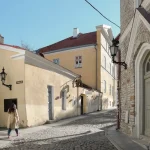
Walk the area around Raekoja plats (Town Hall Square). The Town Hall itself, a 17th-century Swedish baroque building, is one of the few originals that still stands — restored carefully after the war. Around it, you’ll see the strange juxtaposition of wide Soviet-planned streets, blocky apartment buildings, and these occasional baroque stone doorways or archways that have been preserved in isolation, mid-block, with nothing else around them. It gives Narva a ghost-town quality that is unlike anywhere else in Estonia.
The Kreenholm Manufacturing Complex, visible from several points in town, is another layer entirely — a 19th-century textile island-factory that once employed over 10,000 workers. It’s currently undergoing a major redevelopment project expected to open cultural and creative spaces by 2027, but even in 2026 the red-brick mill buildings rising from the river island are striking enough to merit a short detour.
Lunch: Where to Eat in Narva
Narva is roughly 85% Russian-speaking, and the food scene reflects that — which is actually a bonus for curious eaters. You will find pelmeni (Russian dumplings), solyanka soup, and dark rye bread served with pickles and herring far more easily here than anywhere else in Estonia.
Rondeel, the restaurant inside the castle complex itself, is a reliable and convenient choice. The borscht is thick and properly sour, and the location inside the castle courtyard is hard to beat. Mains run €9–€14. It gets busy between 12:00 and 13:30, so either eat early or expect a short wait.

For something more local, walk about ten minutes into town toward Kohvik Singer — a small, no-fuss café that serves hot lunches for €5–€8, popular with locals rather than tourists. The menu rotates daily and is often only in Russian, but pointing works fine and the staff are patient. The smell of fried onions and freshly baked pastry hits you at the door.
Afternoon: Narva’s Soviet Layer and the Riverbank Walk
After lunch, cross to the northern end of the castle and follow the riverside promenade south along the Narva River. This walk takes you past the 2026-renovated riverside park area, opened as part of a cross-border cultural project that — with some irony — was planned jointly with the Russian side before 2022, and completed by Estonia alone. The benches face directly toward Ivangorod, and locals actually use this space regularly: elderly men playing chess, teenagers on bikes, families with prams.
The Soviet residential neighbourhoods further inland — particularly the Pähklimäe and Kreenholm districts — are not conventional tourist territory, but they offer an honest picture of who actually lives here. Narva is Estonia’s third-largest city with around 54,000 residents, the majority of whom are ethnically Russian and have navigated a complicated identity through three decades of Estonian independence. In 2026, with the broader context of the war in Ukraine still very much present, walking these streets has a weight to it that no museum can replicate.
If you have time before your return train, the Narva Art Residency (NART) at Joala 18 hosts rotating contemporary exhibitions and is free or low-cost to enter. In 2026 it continues to programme work that engages directly with the city’s layered identity — some of the most honest art you’ll find in Estonia.
2026 Budget Reality: What a Day Trip to Narva Costs
- Budget (tight): €35–€45 per person. Train or bus return, castle entry, lunch at a local café, one coffee.
- Mid-range: €55–€70 per person. Train return, castle with full museum, lunch at Rondeel, a few extra stops and snacks, taxi from the station.
- Comfortable: €80–€100 per person. Same as above plus a private guided tour (available through Visit Narva for around €25–€30 per person in a small group), dinner before the return train.
Narva is noticeably cheaper than Tallinn for food and coffee. A cappuccino costs €2.50–€3.20 in most cafés, and a sit-down lunch rarely breaks €12 even at the better spots. Budget travellers who pack a lunch and walk everywhere can get away with very little.

Practical Tips for Visiting Narva in 2026
The border crossing is closed. The Narva–Ivangorod pedestrian and road crossing remains closed to tourist traffic in 2026. Do not approach the border zone on foot — the crossing infrastructure is clearly fenced off and monitored.
Language: Russian is the dominant language on the street, in shops, and in many cafés. English is understood at the castle, at tourist-facing venues, and by younger residents. Estonian is spoken but you are in a minority using it. A few basic Russian phrases — spasibo (thank you), pozhaluista (please) — go a long way in terms of warmth.
Safety: Narva is a normal Estonian city under full EU and NATO coverage. The proximity to the Russian border does not create a danger zone for tourists — treat it the way you’d treat any mid-size European border town.
Timing: The castle closes at 18:00. Plan your last sightseeing activity to finish by 17:00 to allow time to walk or taxi back to the station for the evening train. The station has a small waiting room and a kiosk selling snacks.
Weather: Narva winters are cold — expect -10°C to -15°C in January. The castle is open year-round, but the riverside walk is icy. Summer days (June–August) are warm at 18°C–24°C and long, which makes the afternoon river walk genuinely pleasant.
Frequently Asked Questions
Is it safe to visit Narva in 2026?
Yes, completely. Narva is a regular Estonian city inside the EU and NATO. The proximity to Russia draws attention in the news, but there is no threat to tourists on the ground. Normal travel precautions apply, the same as you’d use in any city.
Can you cross into Russia from Narva?
No. The Narva–Ivangorod crossing has been closed to tourist traffic since 2022 and remains closed in 2026. There is no indication this will change in the near future. You can see Ivangorod Fortress clearly from the Estonian side, but you cannot cross.
How long does a day trip to Narva take from Tallinn?
The train takes about two hours and fifteen minutes each way. A comfortable day trip gives you roughly seven to eight hours on the ground — enough to cover the castle, the old town area, lunch, and the riverside walk without feeling rushed.
What language do people speak in Narva?
Russian is the main everyday language for the majority of residents. Estonian is the official language and increasingly used in public services. English works at tourist venues. A few words of Russian are appreciated but not required — locals are generally welcoming to visitors regardless of language.
What is the best time of year to visit Narva?
Late May through September gives the best combination of warmth, long daylight hours, and open outdoor spaces. June and July are ideal — the river is beautiful, the castle courtyards are lively, and the days stretch past 22:00. Winter visits are atmospheric but cold, and the riverside walk requires proper footwear.
Explore more
Where to Shop in Narva: Top Malls, Markets & Local Boutiques
Your Essential Guide to Visiting Narva, Estonia
Where to Go Out in Narva: The Best Bars, Pubs & Nightlife Spots
📷 Featured image by Mariana Mishina on Unsplash.