On this page
- Why Narva’s History Hits Differently in 2026
- The Medieval Fortress Era: Where the Story Starts
- The Swedish Golden Age: Narva’s Brief Moment of Greatness
- The Great Northern War: The Battle That Ended Narva’s Golden Age
- Industrial Revolution on the Narva River: Cotton, Workers & Power
- World War I and the Birth of Estonian Independence: Narva’s Defining Battle
- World War II: Bombed Twice, Rebuilt as a Different City
- Soviet Narva: Rebuilt, Repopulated, Reordered
- Post-Soviet Limbo and the Long Question of Identity
- Narva Today: What Travelers Actually Experience in 2026
- Budget Reality for History Travelers in Narva in 2026
- Practical Tips for Visiting Narva in 2026
- Frequently Asked Questions
💰 Click here to see Estonia Budget Breakdown
💰 Prices updated: October, 2026. Budget figures are estimates — always verify before travel.
Exchange Rate: $1 USD = €0.88
Daily Budget (per person)
Shoestring: €40.00 – €70.00 ($45.45 – $79.55)
Mid-range: €120.00 – €250.00 ($136.36 – $284.09)
Comfortable: €300.00 – €900.00 ($340.91 – $1,022.73)
Accommodation (per night)
Hostel/guesthouse: €15.00 – €40.00 ($17.05 – $45.45)
Mid-range hotel: €60.00 – €150.00 ($68.18 – $170.45)
Food (per meal)
Budget meal: €15.00 ($17.05)
Mid-range meal: €35.00 ($39.77)
Upscale meal: €100.00 ($113.64)
Transport
Single metro/bus trip: €2.00 ($2.27)
Monthly transport pass: €30.00 ($34.09)
Why Narva’s History Hits Differently in 2026
Most European cities with a complicated past have found a way to tidy it up — a museum here, a commemorative plaque there, history safely behind glass. Narva hasn’t done that. In 2026, this city of roughly 55,000 people on Estonia’s eastern edge still wears every century of conflict openly, sometimes awkwardly, always honestly. The Russian fortress of Ivangorod stares directly at the Estonian fortress of Narva across a river that is now a NATO border. A city where roughly 90% of residents speak Russian as their first language sits inside an EU member state that shares a frontier with a country it is legally at war with — in the economic and diplomatic sense — since 2022. If you want to understand how history doesn’t end, it just changes shape, Narva is the place to come. Many travelers in 2026 are finally making the trip specifically because of this tension, not despite it.
The Medieval Fortress Era: Where the Story Starts
The story of Narva as a contested place begins in the 13th century, though the river crossing here was already known to traders and raiders for centuries before that. The Livonian Order — a branch of the Teutonic Knights — built the first stone fortification on the western bank of the Narva River around 1256. This was Livonian territory, meaning the Germanic crusader order controlled it as part of their broader domination of what is now Estonia and Latvia.
The castle they built, known today as Herman Castle or Narva Castle (Hermanni linnus in Estonian), wasn’t just a military outpost. It was a statement of ownership over the crucial trade route connecting the Baltic Sea to the Russian hinterland via the Narva River. Novgorodian merchants needed to pass through here to reach the Gulf of Finland. The Livonians knew this and taxed it accordingly.
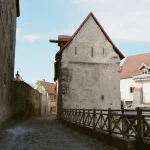
What makes standing inside the castle walls genuinely strange is looking east. In 1492 — the same year Columbus crossed the Atlantic — Ivan III of Russia ordered the construction of Ivangorod Fortress on the opposite bank, almost directly facing Herman Castle. The two fortresses stared each other down across roughly 150 metres of river water. They still do. The sheer limestone walls of Ivangorod, still in Russian territory, are close enough that you can read the texture of the stonework with the naked eye. No other place in Europe offers this — two medieval fortresses from opposing powers, still standing, still facing each other across a live international border.

Herman Castle today houses the Narva Museum, which has significantly expanded its permanent historical collection since 2024. The new medieval gallery opened in early 2025 and walks visitors through the Livonian period with artifact-level detail, including recovered weapons and trade goods from river excavations.
The Swedish Golden Age: Narva’s Brief Moment of Greatness
After the collapse of the Livonian Order in 1561, Narva passed through Russian hands under Ivan the Terrible before Sweden took control in 1581. What followed over the next century was arguably the most prosperous period in the city’s entire history — though few people outside the Baltic region know this.
Under Swedish rule, Narva became a free trade city with direct access to Western European markets. Swedish king Charles XI redesigned the city in the 1680s along Baroque planning principles, with wide streets, a formal town hall square, and substantial merchant houses. At its peak in the late 17th century, Narva was one of the busiest commercial ports on the entire Baltic coast, competing seriously with Riga and Tallinn (then called Reval). Linen, grain, and timber flowed west; manufactured goods flowed east.
Swedish-era Narva was also a university city. The Academia Gustaviana was briefly relocated here, and the intellectual culture of the Swedish empire reached this far. Almost nothing physical from this period survived the 20th century, but the street layout of the city centre still follows the Swedish Baroque grid. Walk it today and you’re walking the bones of a 17th-century Swedish city, even if the buildings above those bones were built in the 1950s.
The Great Northern War: The Battle That Ended Narva’s Golden Age
In November 1700, a Swedish army of roughly 8,000 soldiers under the 18-year-old Charles XII defeated a Russian force of approximately 40,000 under Peter the Great at the Battle of Narva. It was one of the most lopsided military victories of the early modern period and briefly made Charles XII famous across Europe. A blizzard blew directly into the Russian lines at the moment of the Swedish attack, and the larger army collapsed in near-total disorder.
Peter retreated, humiliated, and spent the next four years rebuilding his army from scratch. He came back in 1704 with a force that could not be stopped. Narva fell after a siege, and the Swedish era ended permanently. Peter’s capture of Narva gave Russia its long-sought access to Baltic trade. He later founded St. Petersburg partly as a result of this confidence.
The battlefield site is accessible today and sits just outside the city to the south. There are no formal visitor facilities yet — this is still an open field with a small monument — but local historians offer guided battlefield walks. The Narva Museum holds a dedicated Great Northern War exhibition that opened in 2026 as part of the city’s growing effort to position itself as a destination for military history enthusiasts.
Industrial Revolution on the Narva River: Cotton, Workers & Power
The 19th century transformed Narva’s economy completely. The Kreenholm Manufacturing Company, founded in 1857 on an island in the middle of the Narva River, became one of the largest textile factories in the entire Russian Empire. At its peak, Kreenholm employed over 10,000 workers and was visible from space — or would have been, had satellites existed. The roar of the Narva Falls powering the mills could be heard across the city.
The workers who flooded into Narva to fill those factory jobs came from across the Russian Empire, which permanently changed the city’s ethnic composition. Estonian, Russian, Finnish, and German workers lived in purpose-built tenement blocks around the factory complex. This 19th-century immigration wave is the direct origin of Narva’s Russian-speaking majority — not Soviet deportation policy, as is sometimes assumed, though Soviet-era migration reinforced it further.
Kreenholm’s main production buildings still stand on Kreenholm Island and have been partially converted into cultural and creative spaces since 2022. The transformation accelerated in 2025 when Narva was designated as Estonia’s candidate for European Capital of Culture 2026 programming, bringing additional funding for the Kreenholm cultural campus. Walking through the red-brick Victorian factory halls — the smell of old stone and river damp still present in the unrestored sections — is one of the most atmospheric experiences the city offers.
World War I and the Birth of Estonian Independence: Narva’s Defining Battle
In January 1919, Narva became the site of one of the most consequential military engagements in Estonian history. The newly declared Republic of Estonia, barely weeks old, faced a Bolshevik advance that had already taken much of eastern Estonia. Estonian forces, supported by Finnish volunteers and a British naval squadron in the Gulf of Finland, stopped the Red Army at Narva in fighting that lasted through the winter.

The significance of this victory cannot be overstated for Estonians. Had Narva fallen, the fledgling republic almost certainly would have been absorbed into Soviet Russia before it had a chance to consolidate. The 1920 Peace of Tartu, signed after the War of Independence, gave Estonia internationally recognized borders — including Narva — and was the first international treaty in which Soviet Russia acknowledged another state’s sovereignty.
The Estonian War of Independence is commemorated throughout Narva, though the city’s Russian-speaking majority means this history is sometimes experienced differently by different residents. The memorial at the Narva bridgehead is a quiet, serious place. Visit on February 24, Estonian Independence Day, and you’ll see a ceremony that is genuinely moving — a small crowd in a cold wind, holding the blue-black-white flag at the edge of a NATO border.
World War II: Bombed Twice, Rebuilt as a Different City
Narva suffered some of the most complete destruction of any city in Europe during World War II. German forces occupied the city in 1941. Soviet forces launched a massive offensive in early 1944, and the resulting Battle of Narva lasted from February to August of that year. The city was caught between two enormous military machines.
By the time Soviet forces retook Narva in July 1944, approximately 98% of the city’s pre-war buildings had been destroyed — by German demolitions as they retreated, by Soviet artillery, and by aerial bombing. The medieval town that had survived centuries of earlier conflict was essentially gone. Soviet planners later demolished most of what remained because stabilizing the ruins was deemed impractical.
The Stalinist Soviet city that replaced the destroyed medieval one was built quickly and without sentiment in the 1950s. Wide boulevards, identical apartment blocks, and a handful of civic buildings in the Soviet neoclassical style. This is the Narva that travelers see today when they walk away from the castle. It’s jarring at first — you turn from a 13th-century fortress to a 1950s Soviet streetscape in about 30 seconds. That collision is part of what makes Narva so visually unlike any other Estonian city.
The Town Hall building on Peetri plats is one of the only pre-war structures that survived and was restored. It was moved — physically relocated stone by stone — after the war and reopened in the 1960s. Standing in front of it, you feel the absurdity and determination of that act: saving one baroque building while everything around it was rubble.

Soviet Narva: Rebuilt, Repopulated, Reordered
The Soviet reconstruction of Narva involved more than new buildings. The pre-war Estonian population, many of whom had fled west before the Soviet advance, were largely not permitted to return. In their place came industrial workers from across the Soviet Union, primarily from Russia. New factories — most famously the Baltijets engineering plant — needed workers, and Moscow supplied them.
By 1989, ethnic Estonians made up only around 4% of Narva’s population. The city had been fundamentally and deliberately remade as a Soviet industrial settlement with a Russian-speaking working class. This was Soviet nationalities policy in concrete form, and its effects are the direct reason for every contemporary political debate about Narva’s identity.
The Soviet-era apartment districts — known locally as mikrorajonid — stretch behind the castle in all directions. They are not picturesque. But they are genuinely interesting to walk if you’re thinking about what it means to build an entire urban population from scratch. Some blocks have been renovated with EU funding since 2004; others remain in their original grey render. The contrast within a single street is sometimes striking.
Post-Soviet Limbo and the Long Question of Identity
When Estonia restored independence in 1991, Narva’s residents found themselves in a complicated position. Many held Soviet passports that had no successor state. Estonia created a “grey passport” system — officially a travel document for stateless persons — which in 2026 still applies to a significant portion of Narva’s older population, though the numbers have declined steadily as residents naturalize or take Russian citizenship.
The 1990s and 2000s brought economic collapse as the Soviet factories closed. Unemployment in Narva consistently ran higher than the Estonian national average for two decades. The city’s relationship with Tallinn has sometimes been strained — culturally distant, linguistically separate, economically struggling.
Since Russia’s full-scale invasion of Ukraine in 2022, the context around Narva shifted significantly. Estonia closed the Narva-Ivangorod crossing to Russian passport holders for most purposes in 2022, and while some limited crossing remained possible for a period, by 2026 the border is functionally closed for the vast majority of travelers. Ivangorod Fortress is visible but unreachable. The river is a hard border in a way it hasn’t been since the Cold War. This changes the emotional experience of visiting Narva: the fortress across the water is now truly foreign in a way that felt more theoretical before 2022.

Narva Today: What Travelers Actually Experience in 2026
Walking up to Narva Castle from the main street on a grey October morning, the dark river water below the ramparts moving fast toward the Baltic, the Russian fortress walls filling the opposite bank — this is one of the most genuinely striking urban views in northern Europe, and almost nobody outside the region knows it exists.
The castle complex is the anchor of any visit. The museum inside is well-curated and has improved considerably since 2024. The tower climb offers the clearest view of Ivangorod and the river border. Plan at least two hours here.
The Kreenholm cultural campus holds regular exhibitions, concerts, and events, especially during summer. In 2026, it hosts several projects connected to the European Capital of Culture programming cycle. The old factory cafeteria has been converted into a café and event space — the original industrial ceiling fittings left deliberately intact.
The Narva Art Residency (NART), operating out of a building near the castle, continues to bring international artists to work in Narva and engage with its identity questions. Their public exhibitions are free and often genuinely provocative. The 2025-2026 cycle focused explicitly on border memory and displacement.
The Alexander Cathedral, a large Russian Orthodox church built in the 1880s, is open to visitors and offers a different kind of historical layer — the religious life of the imperial-era Russian community. Candlelight inside on a winter afternoon, the smell of incense settling in cold air, the low chant of a service in progress: it’s a reminder that this city’s Russian connection predates the Soviet period by centuries.
Budget Reality for History Travelers in Narva in 2026
Narva is considerably cheaper than Tallinn for almost everything. Here’s what to expect:
- Narva Museum combined ticket (castle + exhibitions): €10 adults, €5 concessions
- NART gallery entry: Free for current exhibitions
- Kreenholm cultural campus events: Free to €15 depending on event
- Guided battlefield walk (Great Northern War site): €20–25 per person, booked through Narva Museum or local tourism info
- Budget lunch in Narva city centre: €6–9 for a full meal at a local café
- Mid-range dinner: €15–22 per person including a drink
- Budget accommodation (hostel/guesthouse): €20–35 per night
- Mid-range hotel: €55–85 per night
- Comfortable hotel (best available in Narva): €90–110 per night
- Bus from Tallinn to Narva (Lux Express): €12–18 depending on booking window
- Train from Tallinn to Narva: €8–14, journey approximately 2.5 hours — Rail Baltica does not affect this route directly, though upgraded track maintenance along the Tallinn-Narva corridor was completed in late 2025, improving journey reliability

A full day visiting the castle, Kreenholm, and one or two other sites costs most independent travelers between €30–50 all-in, including transport from Tallinn, entry fees, and food. Narva rewards visitors who stay overnight — the evening light on the river and the quietness of the city after 8pm have their own character entirely.
Practical Tips for Visiting Narva in 2026
Border crossing: The Narva-Ivangorod border crossing is open only under strict conditions in 2026 and is not accessible for tourist travel into Russia. Do not attempt to approach the bridge or crossing point without understanding current regulations. Check the Estonian Police and Border Guard Board website before visiting.
Language: Russian is the dominant spoken language in Narva. Estonian is spoken by a minority of residents. English works reasonably well with younger people and at tourist-oriented businesses, but basic Russian phrases help significantly in local shops and cafés. Google Translate with the camera function is useful.
Safety: Narva is safe. The security situation near the border is monitored carefully by Estonian authorities, but the city itself has no elevated crime rate. The area immediately around the castle is tourist-friendly and busy during daylight hours.
Getting there: Direct buses from Tallinn run frequently (Lux Express and others, roughly 3 hours). The train is comfortable and slightly faster with the 2025 track improvements. No direct flights — Narva has no airport.
Getting around Narva: The city is compact and walkable for most historical sites. Local buses serve the outer districts. Taxis are available and cheap by Estonian standards — a ride across town costs €4–7.
Best time to visit for history: May to September for comfortable walking and outdoor site access. February 24 (Independence Day) if you want to see the border memorial ceremony. Midsummer brings a small festival at the castle with period reenactments.
Photography at the border: You may photograph Ivangorod from Estonian territory. Do not photograph military installations, border guards, or surveillance equipment on either side of the river.
Water and practicalities: Tap water is safe to drink. ATMs are available in the city centre. Most businesses accept card payment; some local cafés are cash-only.
Frequently Asked Questions

Is it safe to visit Narva in 2026?
Yes. Narva is a safe city to visit. The proximity to the Russian border does not create a threat to tourists. Estonian security services monitor the border area closely, and the city functions normally as part of the EU and NATO. Standard urban awareness is all that’s needed, the same as any other city.
Can you cross from Narva into Russia in 2026?
No, not for tourist purposes. The Narva-Ivangorod crossing has been closed to most travelers since 2022 following Estonia’s border restrictions in response to Russia’s invasion of Ukraine. EU citizens and most Western passport holders cannot cross here for tourism. Check the Estonian Border Guard website for any updates before visiting.
Can you see Ivangorod Fortress from the Estonian side?
Yes, clearly and dramatically. Ivangorod Fortress sits directly opposite Narva Castle on the Russian bank of the river, separated by roughly 150 metres of water. From the castle ramparts and the riverbank promenade, the view is unobstructed and genuinely impressive. This is one of the most remarkable border views in Europe.
How long should I spend in Narva to understand its history?
A minimum of one full day covers the main historical sites: Narva Castle and museum, the riverside view, Kreenholm, and the cathedral. Staying overnight lets you see the city at a quieter pace and access the battlefield site the following morning. Two days is ideal for anyone with serious interest in the layers of history here.
Why does Narva look so different from Tallinn or Tartu?
Because nearly the entire city was destroyed in World War II and rebuilt from scratch in the Soviet era. Approximately 98% of Narva’s pre-war architecture was lost by 1944. What exists today is almost entirely 1950s Soviet construction, which gives it a completely different visual character from Estonia’s other major cities, where medieval and pre-war buildings survive.
Explore more
Narva in a Day: Your Essential Itinerary for Estonia’s Eastern Gem
📷 Featured image by Dong Zhang on Unsplash.