On this page
- Estonia Uses the Euro — and Has Since 2011
- Contactless Cards and Mobile Pay — How Estonia Actually Works
- The Best Cards to Use in Estonia in 2026
- ATMs in Estonia — When You Actually Need Cash
- Currency Exchange for Non-EUR Cash
- Tipping in Estonia — What’s Expected in 2026
- Paying for Public Transport — Elron Trains and Tallinn City Services
- 2026 Budget Reality — What Things Actually Cost in Estonia
- Common Mistakes to Avoid With Money in Estonia
- Frequently Asked Questions
💰 Click here to see Estonia Budget Breakdown
💰 Prices updated: October, 2026. Budget figures are estimates — always verify before travel.
Exchange Rate: $1 USD = €0.88
Daily Budget (per person)
Shoestring: €40.00 – €70.00 ($45.45 – $79.55)
Mid-range: €120.00 – €250.00 ($136.36 – $284.09)
Comfortable: €300.00 – €900.00 ($340.91 – $1,022.73)
Accommodation (per night)
Hostel/guesthouse: €15.00 – €40.00 ($17.05 – $45.45)
Mid-range hotel: €60.00 – €150.00 ($68.18 – $170.45)
Food (per meal)
Budget meal: €15.00 ($17.05)
Mid-range meal: €35.00 ($39.77)
Upscale meal: €100.00 ($113.64)
Transport
Single metro/bus trip: €2.00 ($2.27)
Monthly transport pass: €30.00 ($34.09)
One question comes up constantly from first-time visitors planning a trip to Estonia in 2026: should I bring cash, exchange money at the airport, or just use my card? The anxiety is understandable — nobody wants to land in Tallinn and find their card declined or discover they’ve been quietly charged a 3% foreign transaction fee on every coffee and museum ticket. The good news is that Estonia’s payment environment is genuinely one of the most visitor-friendly in Europe. But there are still a few specific traps — Dynamic Currency Conversion being the most costly — that catch people out every year. This guide covers everything you need to know to keep your money working for you from the moment you arrive.
Estonia Uses the Euro — and Has Since 2011
Estonia adopted the euro (EUR) on January 1, 2011, replacing the Estonian kroon. In 2026, the euro is the sole official currency. Every price you see on a menu, in a shop window, on a hotel booking site, or at a petrol station is in euros. There are no dual-currency situations, no confusing conversions at the till, and no merchant will accept payment in dollars, pounds, Swedish kronor, or any other currency.
For visitors arriving from other eurozone countries — Germany, France, Finland, the Netherlands — this is completely seamless. Your euros spend identically here as they do at home. For visitors arriving from outside the eurozone (the UK, the US, Canada, Australia, Scandinavia outside Finland, and others), your only concern is how you convert your home currency into euros efficiently and cheaply. The sections below cover exactly that.
One practical note: euro coins and banknotes are identical in denomination across all eurozone countries, but each country mints its own designs on the national side of coins. Estonian euro coins feature the national map or the national bird depending on denomination — a small detail, but one that delights collectors. They spend the same everywhere in the eurozone.

Contactless Cards and Mobile Pay — How Estonia Actually Works
Estonia is consistently ranked among the most cashless societies in Europe, and the situation in 2026 has only moved further in that direction. Contactless card payment is not just accepted widely — it is the default. Walk into a supermarket, a small neighbourhood café, a petrol station forecourt, a museum gift shop, or a Saturday market stall in Tallinn’s Old Town, and you will almost certainly see a card terminal. Finding a mainstream business that refuses card payment is genuinely unusual now.
Which cards work: Visa and Mastercard are universally accepted. If you carry either, you are covered essentially everywhere. American Express is accepted at larger hotels, upscale restaurants, and major retailers, but you cannot count on it at smaller independent businesses. Discover and Diners Club have very limited acceptance in Estonia and should not be your primary payment method.
Mobile wallets: Google Pay, Apple Pay, Samsung Pay, and Garmin Pay all work seamlessly across Estonia. If your bank card is already linked to one of these services, you can tap your phone or smartwatch at any contactless terminal and pay without even reaching for your wallet. This is completely normal behaviour in Tallinn — you will see locals paying for a €1.80 coffee with a flick of their wrist routinely.
On merchant fees: Estonian merchants do not add a surcharge for card payments. The price on the menu is the price you pay — no card fee on top. The cost concern for foreign visitors is entirely on the issuing bank side, meaning the bank that issued your card back home may charge a foreign transaction fee of 1%–3% on every purchase. This is a separate issue from anything Estonia controls, and it is entirely avoidable with the right card (covered in the next section).
The shift since 2024 has been a further decline in cash acceptance at some niche locations. A few food trucks, market vendors, and small artisan shops that previously kept a cash-only sign have moved to card terminals. The infrastructure is there, and businesses have responded.
The Best Cards to Use in Estonia in 2026
This is where visitors from outside the eurozone can save real money. Standard bank cards from the UK, US, Canada, and Australia often carry a foreign transaction fee between 1.5% and 3%. On a €1,500 trip, that’s between €22 and €45 in invisible charges — enough for two decent restaurant meals in Tallinn.
The cleanest solution in 2026 is to use one of the major fintech travel cards. All three of the following are well-established, trusted, and work flawlessly in Estonia:
- Revolut (www.revolut.com): Converts your home currency to euros at the real interbank exchange rate. On the free plan, this is available up to a monthly limit (which resets monthly); above that limit or on weekends, a small markup applies. The paid plans (Revolut Plus, Premium, Metal) remove these restrictions. Revolut is also useful for budgeting — you can see exactly what you spent in Estonia, categorised, in real time.
- Wise (www.wise.com): Formerly TransferWise. Wise charges a small, transparent conversion fee (typically 0.4%–0.6%) and gives you the mid-market rate. There are no hidden markups. The Wise card works at Estonian ATMs and on contactless terminals. For people who want full transparency over exactly what they’re being charged, Wise is arguably the most honest option available.
- N26 (www.n26.com): A fully licensed European bank with no foreign transaction fees within the eurozone. Since Estonia is in the eurozone, spending euros with your N26 card in Tallinn is treated identically to spending euros in Berlin. Available to residents of many European countries and some others. Not available in the US as of 2026.

The practical advice: carry your Revolut or Wise card as your primary payment method, and keep your regular home bank card as a backup in a separate location. Two cards from different networks (one Visa, one Mastercard) gives you the best resilience against card blocks or technical issues.
ATMs in Estonia — When You Actually Need Cash
Cash is not dead in Estonia — it is just far less necessary than in most countries. There are specific situations where having some euros in your pocket is genuinely useful: tipping in cash when the POS terminal doesn’t support tip addition, paying at a remote island guesthouse, buying berries from an elderly vendor at a rural market, or handling an unexpected transport emergency in a smaller town. Having €20–€50 in your wallet covers these situations comfortably for most trips.
Where to find ATMs: In Tallinn, Tartu, Pärnu, and Narva, ATMs are abundant and easy to find. The most common networks belong to Swedbank, SEB, LHV Pank, and Luminor. In smaller towns, there will typically be at least one ATM near the main square or attached to a local shop. In genuinely rural areas and on smaller islands, ATMs may be absent entirely — plan accordingly before heading somewhere remote.

ATM fees in 2026: For cards issued by EU banks withdrawing euros, Estonian bank ATMs generally charge no direct usage fee. For non-EU issued cards, expect a direct ATM fee from the Estonian bank of approximately €2.50–€3.50 per transaction, on top of whatever your home bank charges. To minimise these hits, withdraw larger amounts less frequently rather than small amounts repeatedly.
The Dynamic Currency Conversion trap: This is the single most important thing to know about using ATMs in Estonia. When you insert a foreign card, the ATM will often present a screen offering to convert the amount to your home currency — so instead of withdrawing €100, it shows you the equivalent in USD, GBP, or AUD and offers to charge you in that currency instead. This sounds convenient. It is not. The exchange rate applied by the ATM operator contains a markup of 5%–15% above the real rate. That means you could lose €5–€15 on a single €100 withdrawal purely through this trick.
The correct response is always to decline the conversion and choose to be charged in euros. The exact wording varies by machine — look for “Continue without conversion,” “Charge in EUR,” or “Decline conversion.” Never select your home currency at an ATM in Estonia.
Step-by-step ATM withdrawal:
- Find an ATM attached to a bank branch if possible — better security and usually maintained more reliably.
- Insert your card and enter your 4-digit PIN.
- Select “Withdrawal” — in Estonian this is “Sularaha väljavõtmine,” but English is available on all major bank ATMs.
- Enter the amount you want. ATMs typically dispense €10, €20, and €50 notes.
- When the currency conversion screen appears, select “Continue without conversion” or “Charge in EUR.” Do not select your home currency.
- Confirm and collect your cash and your card.
- If an ATM looks physically tampered with — loose panels, unusual attachments around the card slot — walk away and find another.

Currency Exchange for Non-EUR Cash
If you arrive in Estonia holding US dollars, British pounds, Swedish kronor, or another non-euro currency in physical cash, you will need to exchange it. The honest assessment: this is an increasingly rare necessity in 2026, because using an ATM or a fintech card to access euros is almost always cheaper and more convenient. But if you have cash to exchange, here is how to do it without losing more than necessary.
Tavid is Estonia’s leading and most reliable currency exchange service. Their website is www.tavid.ee, where you can check current rates before you visit a branch. Tavid has locations at Tallinn Airport (Lennart Meri Tallinn Airport, TLL) and in central Tallinn, including branches at Viru Keskus (Viru väljak 4/6) and Rotermanni Kvartal (Rotermanni 5). The city centre branches consistently offer better rates than the airport branch — sometimes by a meaningful margin.
Airport vs city rates: The airport Tavid branch is convenient if you land with non-euro cash and need euros immediately, but the rate will be less favourable than what you get in the city. If you can manage with your card for the taxi or bus into central Tallinn, exchange your cash once you reach a city centre branch.
What about banks? Most major Estonian banks — Swedbank, SEB, Luminor — no longer provide over-the-counter cash currency exchange for non-account holders. Do not walk into a bank branch expecting to exchange dollars for euros across a counter. The banking model here is primarily digital, and physical foreign exchange services at bank branches have largely disappeared.
Understanding Tavid’s rates: Tavid advertises zero commission, which is accurate — they make their money on the spread between the buy and sell rates. Check the “WE BUY” rate (the rate they pay you for your currency). Compare that to the current interbank mid-market rate, which you can check instantly on Google or XE.com (www.xe.com). The difference between those two numbers is your real cost. A spread of 2%–5% is typical for physical cash exchange anywhere in Europe.

Step-by-step at Tavid:
- Check the current “WE BUY” rate for your currency at www.tavid.ee before you leave your accommodation.
- Visit a city centre branch with your cash and your passport (required for amounts over €1,000 equivalent, in line with anti-money laundering regulations).
- Confirm the rate displayed on the board matches what you expected.
- Hand over your cash, receive euros and a receipt.
- Count your euros at the counter before stepping away.
Tipping in Estonia — What’s Expected in 2026
Tipping culture in Estonia is relaxed and unpressured. There is no American-style social obligation, no pre-set tip percentage added to your bill, and no expectation that you will leave exactly 15% or 20%. Locals tip because they want to, not because they feel they must. As a visitor, the same rule applies.
Restaurants and cafés: The most common approach is rounding up. If your bill is €28.50, you hand over €30 or tell the card machine to charge €30. For genuinely good service — a server who checked in without hovering, made a good recommendation, handled a busy Saturday night smoothly — 5%–10% is a warm and appreciated gesture. No one expects more than that. Before you leave any tip on the bill, glance at the receipt quickly to confirm no service charge has already been included. This is rare, but it happens occasionally in very tourist-heavy spots in Tallinn’s Old Town.
The smell of butter and herbs from a freshly delivered plate of grilled pike-perch at a candlelit Tallinn restaurant is exactly the kind of moment that makes rounding up feel natural rather than obligatory. When the service matches the food, acknowledging it costs little.

Bars: Rounding up the tab or leaving a coin or two on the bar for friendly service is perfectly appropriate. No one will look at you oddly if you don’t tip at a bar.
Taxis and ride-hailing: Round up the fare. A €8.70 Bolt ride becomes €9 or €9.50. For a longer airport run or especially helpful driver, a slightly more generous rounding is appreciated but never expected.
Hotels: Porter assistance with luggage — €1–€2 per bag is a polite gesture. For housekeeping on a multi-night stay, leaving €5–€10 in cash under the pillow or on the bedside table upon departure (not left ambiguously mid-stay) is a considerate acknowledgement of good service. It is not expected, but it is noticed.
Hairdressers and beauty salons: Not customary. Pay the stated price and leave.
Paying for Public Transport — Elron Trains and Tallinn City Services
Estonia’s public transport payment systems are among the most modernised in the region, and navigating them as a visitor in 2026 requires almost no preparation.
Tallinn city transport (buses, trams, trolleybuses): The simplest method for short-stay visitors is to tap your contactless bank card — Visa or Mastercard — directly on the validator inside the vehicle when you board. The system charges the standard single-journey fare, which sits at approximately €2.00 in 2026 based on the trajectory from 2024 pricing. No app, no top-up card, no ticket machine queue. You tap, it beeps, you’re valid. QR-code tickets are also available through apps including Pilet.ee and Ridango if you prefer that route.
The Ühiskaart (the dedicated Tallinn public transport smartcard) is available for residents and frequent users, but for a visit of a few days, tapping your bank card directly is faster and simpler. Skip the smartcard unless you’re staying for a week or more and making multiple journeys daily.

More information on routes and fares is at www.tallinn.ee/eng/transport.
Elron national trains: Elron operates Estonia’s rail network — Tallinn to Tartu, Tallinn to Pärnu, Tallinn to Narva, and several regional routes. The most convenient way to book is through the Elron website (www.elron.ee) or the Elron mobile app, which lets you choose seats on longer routes and store your ticket digitally. Ticket machines at major stations including Tallinn Balti Jaam and Tartu accept contactless card payments and cash. You can also buy from the on-board conductor, who accepts both cash and contactless cards — but note that a surcharge of €1.00 applies for single paper tickets purchased on board if a ticket machine was available at your departure station.
A standard adult ticket from Tallinn to Tartu — a journey of just under 2.5 hours through the gently rolling Estonian countryside, with birch forests pressing close on either side of the track — costs between €8.50 and €12.00 depending on travel class and how far in advance you book.
2026 Budget Reality — What Things Actually Cost in Estonia
Understanding exchange rates and payment methods only makes sense alongside a realistic picture of what you will actually spend. These are 2026 figures reflecting current pricing trends in Estonia.
Accommodation (per night)
- Budget: Hostel dorm bed in Tallinn — €18–€30
- Mid-range: 3-star hotel or well-rated guesthouse — €70–€130
- Comfortable: 4-star hotel in Tallinn Old Town or Kalamaja — €150–€250+
Food and drink
- Budget: Supermarket lunch (Rimi, Selver, or Maxima) — €4–€7. The earthy warmth of a dark rye bread sandwich from a Selver bakery counter costs under €2 and keeps you going for hours.
- Mid-range: Sit-down lunch at a café, soup and main — €10–€16
- Comfortable: Dinner at a quality Estonian restaurant, two courses without drinks — €25–€45 per person
- Coffee: Espresso or flat white — €2.50–€4.00
- Local beer (0.5L at a bar): €3.50–€5.50

Getting around
- Tallinn city bus or tram, single journey: ~€2.00
- Bolt taxi, central Tallinn short ride: €5–€12
- Tallinn–Tartu train (standard adult): €8.50–€12.00
- Tallinn airport taxi to Old Town: €12–€18 depending on traffic and provider
Activities and entrance fees
- Budget: Tallinn Old Town is free to walk. Many parks and coastal areas cost nothing.
- Mid-range: Kumu Art Museum adult ticket — €14. Tallinn City Museum — €8.
- Comfortable: Day trip guided tour from Tallinn (Lahemaa National Park) — €45–€75
Common Mistakes to Avoid With Money in Estonia
Accepting Dynamic Currency Conversion at ATMs or card terminals: When any machine — ATM or card payment terminal at a shop — offers to charge you in your home currency, always decline. Always choose euros. The rate offered contains a markup of 5%–15% and is never in your favour.
Relying on American Express as your only card: Amex works in larger hotels and upscale restaurants, but you will hit situations — a neighbourhood café, a smaller museum, a local market — where it is not accepted. Always carry a Visa or Mastercard as your primary card.
Exchanging currency at the airport when you don’t need to: If you are arriving with a working contactless Visa or Mastercard, you do not need to exchange cash at the airport. Take a Bolt taxi or the bus into the city using your card. Exchange cash only if you genuinely have a pile of non-euro banknotes to convert, and do it at a city centre Tavid branch, not the airport branch.
Carrying no backup card: Cards get lost, blocked by fraud alerts, or swallowed by machines. If you have only one card and it stops working on day two of your trip, you face a genuine problem. Carry two cards from different banks and preferably different networks. Keep them in separate places — wallet and bag, not both in the same wallet.

Assuming all small businesses take cards: The situation has improved dramatically, but very remote guesthouses, some rural farm shops, and occasional market vendors still operate cash-only. If you are heading to Saaremaa, Hiiumaa, or any rural area for more than a day or two, carry at least €40–€60 in cash as insurance.
Not checking your home bank’s international fee structure before leaving: This is money lost silently. Check your bank’s fee schedule before you travel. If the fees are significant, opening a Revolut or Wise account before your trip takes about 15 minutes and can save you €30–€80 over the course of a typical visit.
Frequently Asked Questions
Do I need to bring cash to Estonia, or can I use my card everywhere?
You can use a contactless Visa or Mastercard in almost every mainstream establishment in Estonia in 2026. Cash is useful as a small backup — €20–€50 covers tips, rural market purchases, and genuine edge cases. Do not exchange large sums of cash before your trip; your card will serve you better in nearly every situation.
What is Dynamic Currency Conversion and how do I avoid it?
Dynamic Currency Conversion (DCC) is when an ATM or card terminal offers to convert your transaction from euros into your home currency on the spot. The rate applied includes a hidden markup of 5%–15%. Always decline this option and choose to be charged in euros. Look for “Continue without conversion” or “Charge in EUR” on the screen.
Is tipping expected in Estonian restaurants?
Tipping is appreciated but not mandatory in Estonia. The most common practice is rounding up the bill to the nearest convenient amount. For notably good service, 5%–10% is considered generous. No service charge is automatically added in most restaurants, but check your receipt to confirm before leaving an additional amount.
Which currency exchange service is best in Estonia?
Tavid (www.tavid.ee) is the most reliable and widespread currency exchange provider in Estonia. For better rates, use their city centre branches in Tallinn rather than the airport location. Compare their offered rate to the mid-market rate on XE.com before exchanging. For most visitors, using an ATM or fintech card is still a better option than exchanging physical cash.
What are the best travel cards to use in Estonia in 2026?
Revolut (www.revolut.com), Wise (www.wise.com), and N26 (www.n26.com) are the top options for minimising costs in Estonia. They offer the real interbank exchange rate with minimal or zero foreign transaction fees. Set up your preferred service before travelling, as card delivery and verification can take several days.
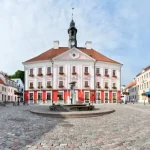
📷 Featured image by Julio Lopez on Unsplash.